Groundbreaking project towards CO2-neutral cement

For dansk version, læs venligst her.

The ACCSION project – Carbon capture with international scope and local roots

With ACCSION, Aalborg Portland is taking a significant step toward its 2030 climate goal. In collaboration with Air Liquide – a global leader in gases, technologies, and services for industry and healthcare – a fully integrated onshore CO₂ capture value chain is being established in Northern Jutland.

ACCSION stands for Aalborg Portland Carbon Capture & Storage using Infrastructure Onshore in North Jutland and will be one of the first projects in the EU to cover the entire CO₂ value chain – from capture and transport to safe underground storage. The project is a key part of Aalborg Portland’s climate plan toward 2030 and has been awarded DKK 1.6 billion in funding from the EU Innovation Fund.

Aalborg Portland, in collaboration with Air Liquide, will develop, construct, and operate the CO₂ capture plant, which is expected to reduce CO₂ emissions by up to 1.5 million tons annually from 2030. This will enable the production of CO₂-neutral cement in Denmark.

Project Information:

  • Location: Aalborg, Denmark
  • Technology: Cryogenic technology (Cryocap™) enables high-purity CO₂ capture from cement kilns.
  • Technology Partner: Air Liquide
  • Funding: 1.6 billion DKK from the EU Innovation Fund

A New Standard for CO2 Capture in the Cement Industry

ACCSION represents a significant technological advancement in carbon capture and storage (CCS) and could be pivotal for the future of cement production in Europe. Its groundbreaking nature is one of the reasons it was selected for EU Innovation Fund support.

It will be the first project in Europe to establish a fully integrated onshore CO₂ value chain. CO₂ is captured directly from cement production, transported via pipeline to a reception facility, and safely stored underground. It is also the first project at this scale to combine CO₂ capture from both grey and white cement – a solution not yet implemented in the industry.

The capture process uses Air Liquide’s Cryocap™ technology, which enables efficient collection of CO₂ from multiple flue gas streams in a single unit. Additionally, digital technologies and advanced data analytics will ensure remote control and continuous monitoring of the facility.

The capture plant will also be connected to Aalborg’s district heating system, allowing the heat generated during the process to be reused for local energy supply – enhancing the overall climate impact and embedding the project in the local community.

Expected Results and Climate Impact:

  • Annual CO₂ capture of 1.42 million tons from 2029/30 – equivalent to emissions from approx. 750,000 passenger cars annually (according to the The European Environment Agency)
  • First cement plant in the EU with both grey and white cement production without scope 1 emissions – together with a shift to greener fuels and new product development, ACCSION will enable CO₂-neutral cement at Aalborg Portland.
  • Utilization of 80 MW of surplus heat from the capture process for district heating in Aalborg – equivalent to heating approx. 19,100 households annually.
  • A milestone for Denmark’s and the EU’s climate goals – the project alone will contribute 38% of the required industrial reductions for Denmark’s 2030 target and support the EU’s 2050 climate neutrality goal.
  • Proves that onshore CO₂ storage is technically feasible and effective – a crucial development for future CCS solutions in Europe, with potential for land-based storage of up to 112 million tons/year by 2050.

The ACCSION project is a major step toward a more sustainable cement industry and an important contribution to the green transition. Learn more about how Aalborg Portland is transforming cement production in our Roadmap 2030 here.
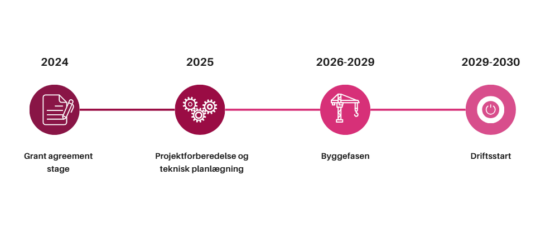
Project Timeline:

Illustrations af tidslinje for Aalborg Portlands carbon, capture and storage ACCSION projekt.

  • 2024–2025
    Grant Agreement phase
    Formal agreements and financing structures are established, and project goals and costs are defined.
  • 2025–2026
    Preparation and technical planning
    Technical requirements and detailed cost estimates are developed.
  • 2026–2029
    Construction phase
    The facility is built, and technological components are installed.
  • 2029–2030
    Operational launch
    Systems go live, and CO₂ capture and storage become an integrated part of production.


Technology and Sustainability

ACCSION uses Air Liquide’s Cryocap™ technology to capture and purify CO₂ from both grey and white cement production. This “cluster capture” approach creates economies of scale and efficient operation.

A key element is integration with Aalborg’s district heating system, where 80 MW of surplus heat is reused to heat thousands of homes.
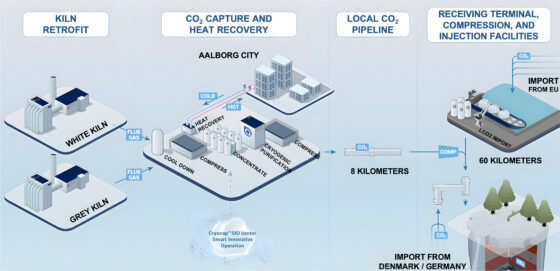
Illustration af hele ACCSION-projektets og dets værdikæde samt teknologien bag.

Illustration of ACCSION

The electricity for the capture plant will be sourced from renewable energy, and Aalborg Portland will use certified biogas in its kilns to maximize CO₂ reduction and achieve production without scope 1 emissions.

FAQ: Understanding CCS

Q1: Why is CCS necessary for Aalborg Portland?

Decarbonizing the cement industry requires CCS technology because CO₂ is an unavoidable by-product of the production process. The majority of our CO₂ emissions come from the raw material chalk, which is an essential component in all cement production. When chalk is heated and processed to produce cement, it naturally releases bound CO₂ — and this is where CCS becomes essential.

Q2: Is CCS safe?

Yes, CCS is safe. The captured CO₂ is stored in underground storages that have been thoroughly assessed for long-term stability and safety. The technology has been tested and used in various industrial contexts and complies with strict safety standards. Learn more about CO₂ storage at www.greenstore.dk.

Q3: How does CCS fit into Aalborg Portland’s sustainability goals?

CCS is a central part of our strategy to achieve climate neutrality by 2030 by reducing CO₂ emissions from cement production. In addition to CCS, emissions reductions will come from transitioning to alternative fuels and developing new product types. Read more in our 2030 roadmap – Aalborg Portland.

Q4: What are the challenges of implementing CCS?

CCS requires significant investments in infrastructure, energy, and technology. The ACCSION project partners have therefore entered into several agreements and are working closely with key stakeholders to secure funding and stay on schedule.

Q5: Why don’t you use the captured CO₂ for Power-to-X (PtX)?

Part of the captured CO₂ is planned to be stored, but we are of course also exploring potential partnerships where the CO₂ can be utilized. A number of local companies in Aalborg and Northern Jutland are among the world leaders in PtX technologies, and the CO₂ could be used here. However, it is still too early to say more on this, but we are continuously exploring the market.


Funded by the European Union. Views and opinions expressed are however those of the author(s) only and do not necessarily reflect those of the European Union or the European Climate, Infrastructure and Environment Executive Agency (CINEA). Neither the European Union nor the granting authority can be held responsible for them.
Kontaktperson
Søren Konstmann Lausen
Technical and Special Projects Business Partner
Mobil +45 2429 1277
Send e-mail
